/* */ retirement – Vine Maple Farm

Marv Waschke’s New Mystery

This week Vine Maple Farm Press published my latest mystery, Blind Man, on Amazon in both Kindle edition and paperback. You can obtain it here. I’m an over-productive and under-disciplined writer, starting projects without finishing them, finishing projects and forgetting about them. But over the past few months, I’ve set my jaw and whipped a segment of a sprawling manuscript into shape as the first book in the Blind Detective series.
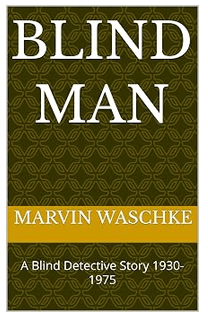
It’s a comic crime story set in the 1930s through the 1970s. The main character is a blind detective. As the first book in the series, it includes the main character’s early life. The main story portrays the rescue of an illegal and corrupt—but socially beneficial—gambling scheme run by a notorious crook.

The story is indebted to the classic crime fiction, to Raymond Chandler’s cynical Marlowe and Rex Stout’s wise-cracking Archie. The victim in Blind Man is not a person; instead society is ruthlessly assaulted by forces drifting out of control. Nothing is clear in the dark world of the blind detective. No one, not even the blind man himself, can be trusted.
The story takes place in mythical Chicago, beginning before WWII. Julius “Julie” Parnak is the nephew of the head of the Chicago franchise of Murder Inc., which Julie’s uncle took over from the New York outfit. Julie inherits his uncle’s operation, but he lacks his uncle’s administrative cunning and wit. The blind man, Fenton Herzman, a cellist who lost his sight in Julie’s presence, is an adjunct professor at South Side University. He has established a private detective agency to fund his expensive tastes in antique cellos and baroque music manuscripts.

The skeptical narrator, Reggie Haskell, is from rural Minnesota. He becomes the blind man’s eyes and hands on the streets. Haskell has a rabbit pistol, a flair for baroque musical ornamentation, and a jaundiced eye. Reggie’s dark and looming sidekick, Fellman Biggers, is a former NFL tackle with a PhD. in astrophysics. Reggie and Fellman are heroes; Herzman’s willing pawns in a storm-tossed sea of deception, greed, and spite.

Return To Waschke Road

We, Rebecca and I, have been living on Waschke Road nearly two months now. Albert and Victoria, our dogs, are used to being back on the road in a new house with a larger yard, but I can’t say that we are settled in.

This house is much smaller than our previous two houses, has many minor and not so minor things that need repair, replacement, or change to suit us. I begin each day with a task list that grows longer as the day goes on. I think that some morning, I’ll wake up and the list will be empty, but, somehow, I know that day will not come.

The decision to move back was hard. We loved the Ferndale house and the Gardiner Terrace neighborhood. The kitchen and the layout of the house is as perfect as I could imagine. I’ve never taken much interest in local politics, but I enjoyed learning about Ferndale city government and began to think that I might be able to help a growing city of wonderful people that seemed to need lessons on how to grow. A city that builds sleek new streets but fails to maintain the old, continually playing catchup on infrastructure, and generally fumbling its value proposition might benefit from my experience with corporate infighting and governance.

But I put those thoughts behind us when Rebecca’s surgeon recommended a fourth back surgery as soon as the covid-19 lockdown was lifted.

After your fourth trip to the rodeo, you begin to plan for your next visit. The Ferndale house with two stories and spacious layout would not work for us any longer. We thought about installing a chair lift but adding another complex device to our lives was not an answer we liked. We already owned a house that is an easy walk from our children and grandchildren, single story, a ramp to the front door, with space for my office and Rebecca’s craft studio, and a panoramic view of Mount Baker’s glaciers and buttes presiding over fields that my father, grandfather, and now our son, have farmed for over a century. The tenants who were renting the house were ready to move on to purchasing their own house. The instant we finished thinking it through, the decision was obvious.

So here we are. Albert, the border collie, and I are back to walking up and down Waschke Road several times a day, waving to the neighbors, treading paths and looking at sights that I have tread on and looked at my entire life.

Feels good. Not what we expected a few years ago, but we had soup made from kale grown by our farmer son and daughter-in-law last night. Feels good.

My Failed Background Check

A couple months ago, I noticed an online request for volunteer mentors at my old high school. Since I am retired and recently moved to within a few blocks of the school, I followed a whim and volunteered.

Me at FHS 1966

Although I didn’t appreciate FHS at the time, Ferndale’s teachers in the late 1960s were good: I think of Miss Wynne in mathematics, Don Buzzard, chemistry and physics, and Roy Bentley, English. All taught well, even challenged an obnoxious know-it-all like me. When we graduated, both my cousin Dave and I received scholarships from the University of Chicago, an institution that is regularly ranked as one of the top ten universities in the world. I was given an “Honors At Entrance” certificate and placed into honors math and chemistry classes with students from high caliber places like the Bronx High School of Science, went on to graduate with honors, and received a fellowship for graduate study.

This reflects well on FHS, but not that well on me. Unlike most of my peers on the South Side of Chicago, no stellar career followed my distinguished UChicago education. In fact, I had to completely reboot my life after stumbling through graduate school. But fifty years later, I thought it was time to repay an old debt by listening to a kid or two at FHS.

Volunteering at the high school is not what it used to be. When Ferndale had a three-digit population, a few calls, a few people to vouch for you, and the school had a clear idea of who you were and if you could be trusted with kids. Now, you have to go through a background check with the state patrol. That’s sensible. People move around now. Communities work differently. People are not the easily measured quantities they once were.

To get a background check, you have to be finger printed. As best I can remember, the only time my prints were taken prior to volunteering, was at the 1959 Scout-O-Rama at Battersby Field in Bellingham. I brought home a card with a thumb print and an inky thumb. With that history, I expected to pass with flying colors.

I failed. My finger prints were unacceptable.

On the first try, my finger print quality scores were low and I googled not having finger prints. Between one and two percent of people fingerprinted fail to produce readable prints. Apparently, thirty years of pounding computer keyboards wore the ridges on my fingers into illegible smears. The decade I spent as a carpenter dipping my hands into caustic wet cement must not have helped. The experts advise lots of hand lotion for weeks prior to printing to “plump the ridges.” I bought a bottle of the cheapest hand lotion I could find at Winco and spread it on when I thought of it, afterwards peering at my finger prints under a strong light and magnifying glass, hoping to see ridges rise like tectonic fault lines. Hah.

My finger prints were taken at the Ferndale Police Station. When I went back for a second try, two experts worked me over. They don’t use ink pads any more, now it’s a computerized scanner. They ordered me to rub on Corn Huskers Lotion, then clean my finger tips with some special wipes, and the polished the screen on the scanner. Then they went to work, taking turns rolling my fingers and thumbs. The computer gave my prints low grades, even on the second try.

I went home feeling pessimistic. I might still be able to purchase an assault rifle at a gun show, but I couldn’t volunteer at the high school. If a tin can had been lying on the sidewalk, I would have kicked it home.

I passed. My finger prints were clear enough and the speeding ticket on a winter morning in 1991 passing through Mount Vernon when I was afraid I would be late for work in my office in Bellevue did not disqualify me from volunteering.